
3D Shapes and Their Properties
Year 3 learn the names and properties of common 3D shapes.
# 3D Shapes and Their Properties
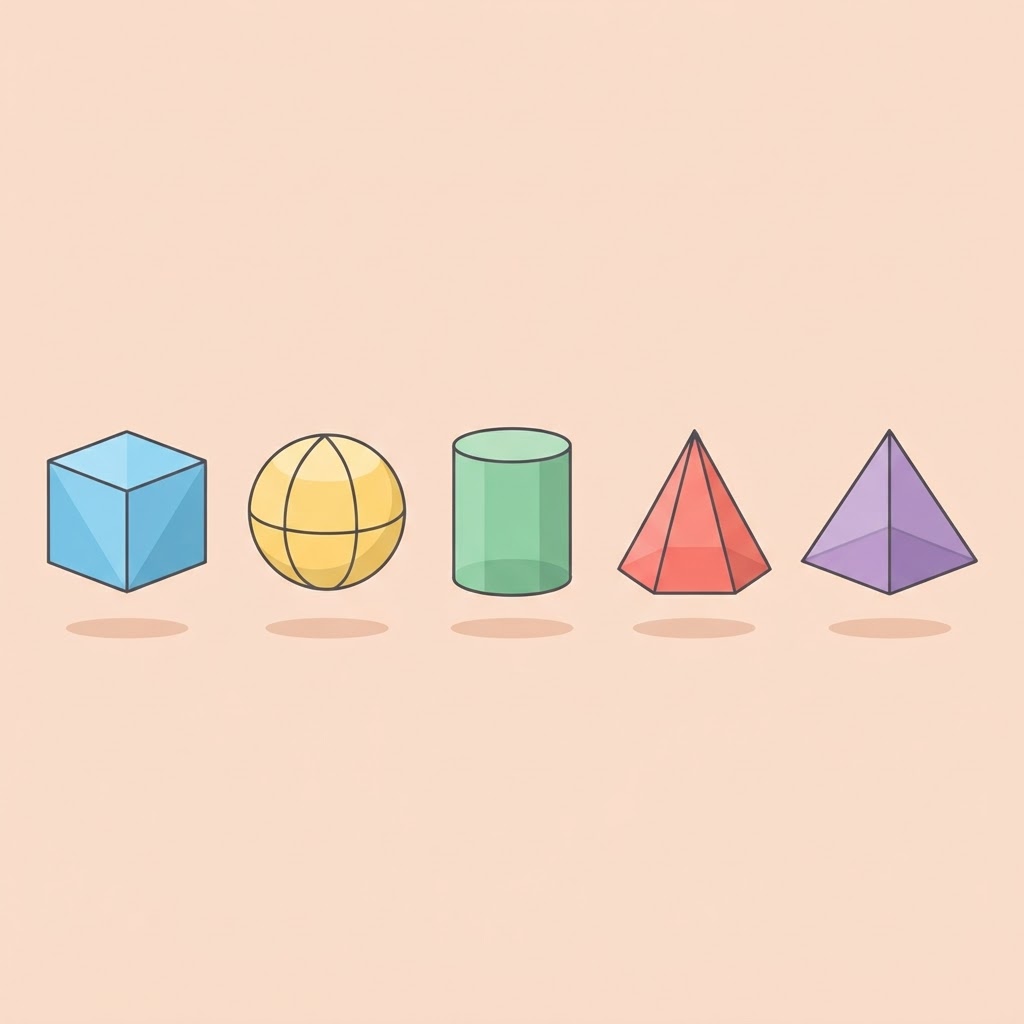
Flat shapes are 2D, but the objects we hold are 3D. Three dimensional shapes have length, width and depth. This lesson introduces the names and properties of the most common 3D shapes.
Faces, Edges and Vertices
A face is a flat surface of a 3D shape. An edge is where two faces meet. A vertex, or corner, is where edges meet. A cube has six faces, twelve edges and eight vertices. Counting these helps children describe a shape clearly.
The Cube
A cube has six square faces that are all the same size. Dice and some boxes are cubes. Because every face is a square, every edge is the same length and every angle is a right angle.
The Sphere
A sphere is perfectly round, like a ball. It has one curved face and no flat faces, no edges and no vertices. A sphere is the only 3D shape with a single curved surface and nothing else.
Cylinders, Cones and Pyramids
A cylinder has two circular faces and one curved face, like a tin of beans. A cone has one circular face and a curved face that meets at a point, like an ice cream cone. A pyramid usually has a square base and four triangle faces that meet at the top.
3D Shapes at Home
Go on a hunt for 3D shapes at home. Tins are cylinders, balls are spheres and dice are cubes. Finding these shapes in real life helps children connect flat pictures of 3D shapes with the objects they can touch.
Related Resources
Need worksheets for this topic? Generate a personalised worksheet or browse our collection.