Shapes All Around Us
Year 1 discover that shapes are everywhere and learn the first names of 2D shapes.
# Shapes All Around Us
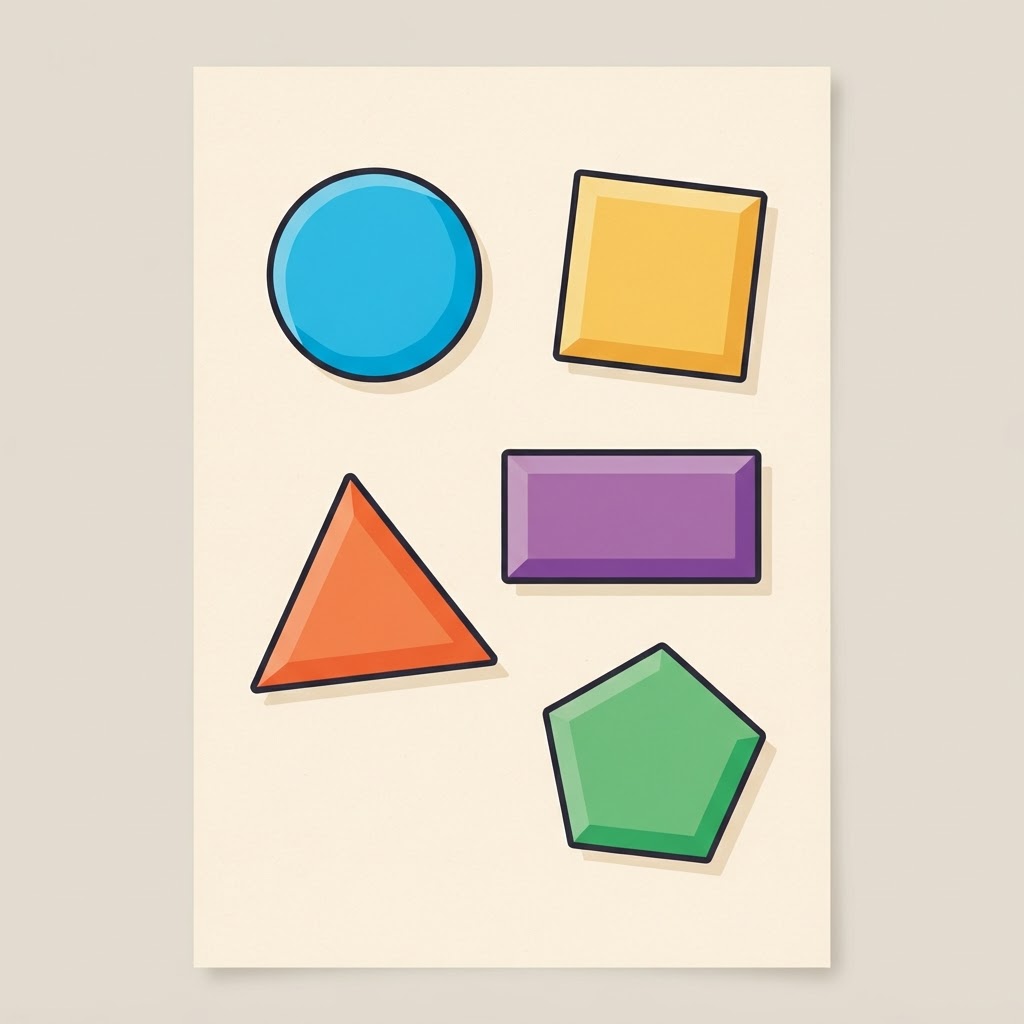
Geometry begins with noticing shapes. Long before children learn the names of shapes, they spot them everywhere. A window is a rectangle, a plate is a circle and a slice of toast is often a square. This first lesson helps children see that the world is full of shapes to discover.
Flat Shapes Are 2D Shapes
Flat shapes lie on a surface and are called 2D shapes because they have two dimensions, length and width. The common 2D shapes children meet first are the circle, square, triangle and rectangle. Pointing these out at home and on walks builds a strong foundation for later geometry.
Sides and Corners
A side is a straight edge of a shape. A corner, sometimes called a vertex, is where two sides meet. A triangle has three sides and three corners. A square has four of each. A circle has no straight sides and no corners at all, which makes it special.
A Shape Hunt
Go on a shape hunt around your home. Look for circles on clocks and plates, squares on tiles and books, rectangles on doors and triangles on slices of pizza. Keep a tally of how many of each you find. Talking about the shapes helps the names stick.
Making Shapes
Children learn by doing. Try making shapes with play dough, sticks or even your fingers. Drawing shapes in a tray of salt or sand is a lovely sensory way to practise. The more children make and name shapes, the more confident they become.
Why This Matters
Naming and describing shapes is the first step in geometry. It also helps with counting, sorting and describing the world. Spotting shapes now prepares children for learning about sides, corners and angles later on.
Related Resources
Need worksheets for this topic? Generate a personalised worksheet or browse our collection.